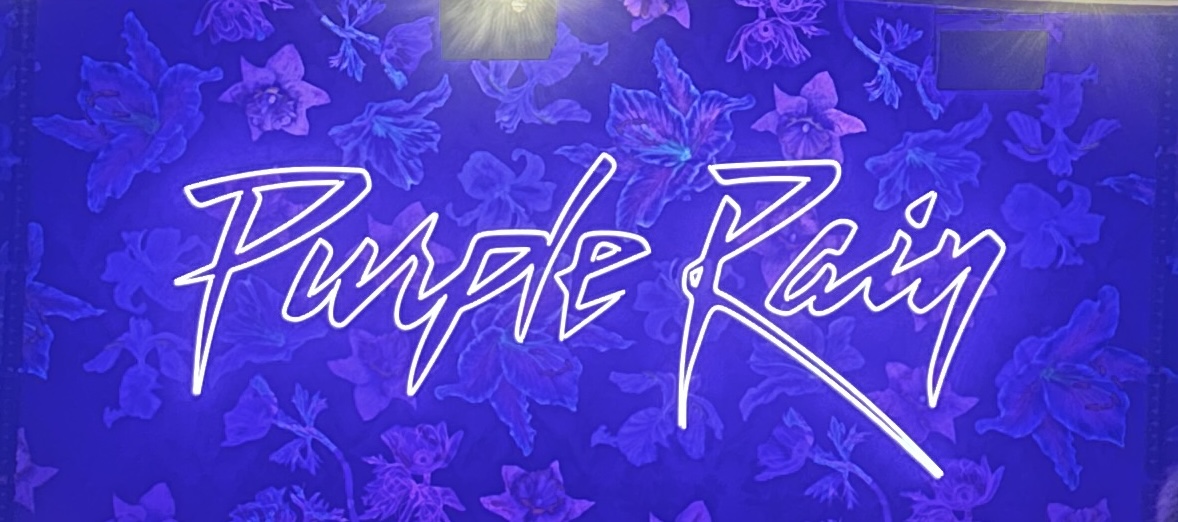
The announcement in early 2024 that Purple Rain, Prince‘s breakout film, would be adapted for the stage created a frenzy of conversation and controversy. Co-stars from the original film, former band members, and diehard Prince fans (or, as he affectionately referred to us, “fams”) all had something to say. We flooded the former bird app with hot takes, skepticism, and, as is particularly on brand for the fam-dom, the standard “Prince was more than Purple Rain/he has so many other albums/the estate needs to open up the vault” commentary.
Those initial reactions weren’t unexpected, especially from the most dedicated of Prince’s global fanbase. Purple Rain is a defining moment in pop culture, and for that reason alone there are more than a few reasons the mere suggestion of a remake or do-over would ruffle feathers. At a time when social media is regularly inundated with groans from consumers begging for “something new” instead of rehashed IP, it’s not all that surprising that a proposed stage production of one of the most important films not just of the 1980s but of all time would be met with some serious side-eye.
Add to that, a kind of Purple Rain fatigue amongst some within the deep Prince community. Although there have only been 5 official Purple Rain-related posthumous releases (2017’s Purple Rain Deluxe Edition, which Prince had reportedly green lit a few years before he died; the remastered Prince and The Revolution: Live CD and Blu-Ray set, followed later by a vinyl edition; and more recently, the remaster of the original Purple Rain album in Dolby Atmos and the release of the film in 4k), those projects–coupled with a copious amount of Purple Rain merch (umbrellas, t-shirts, hoodies, mugs, and the rain boots that nearly caused a riot), there’s a general consensus among many of the dearly beloved devotées that there’s been too much emphasis on the film, album, and era that made Prince a global super star.
During Celebration 2024, which was fully dedicated to commemorating Purple Rain‘s 40th anniversary, fams had the opportunity to experience the musical in the making as it was being workshopped. With Broadway star Rachel Webb cast as Apollonia and The Revolution’s Bobby Z and the New Power Generation’s Morris Hayes on hand as musical consultants, attendees got a first taste of what was to come with a live performance of several songs, including a gorgeous arrangement of “Take Me With You.” At that time the role of The Kid, the character Prince portrayed in the film, had yet to be cast. For me, that sneak peek sold me on the concept of the musical. As someone who believes that art is meant to be reinterpreted and reimagined, I’d already decided to wait and see before making up my mind about this new vision of a culture-shifting film produced for the stage. The creative team (Tony and Pulitzer Prize winner Branden Jacobs-Jenkins, book; Tony Award nominee Lileana Blain-Cruz, director; Emmy-winning choreographer Ebony Williams; and Tony and Drama Desk Award-winner Jason Michael Webb, music supervision, orchestrator, and arranger) are all Black and/or POC and also represent the LGBTQ+ community, which made me even more comfortable that this project was in good and capable hands. Despite some opinions to the contrary, Prince’s music was always rooted in and informed by his culture, his experiences growing up as a Black midwesterner, and his personal connection to Black music lineage and history. So it matters that the folks at the helm of this musical share similar cultural touch points.
Tickets for the show went on sale not long after Celebration, with an opening date set for April 2025. Within weeks of the pre-sale, however, the opening was pushed back to October. And it wasn’t until this summer that the production revealed its star, acclaimed singer and actor Kris Kollins, cast as The Kid.
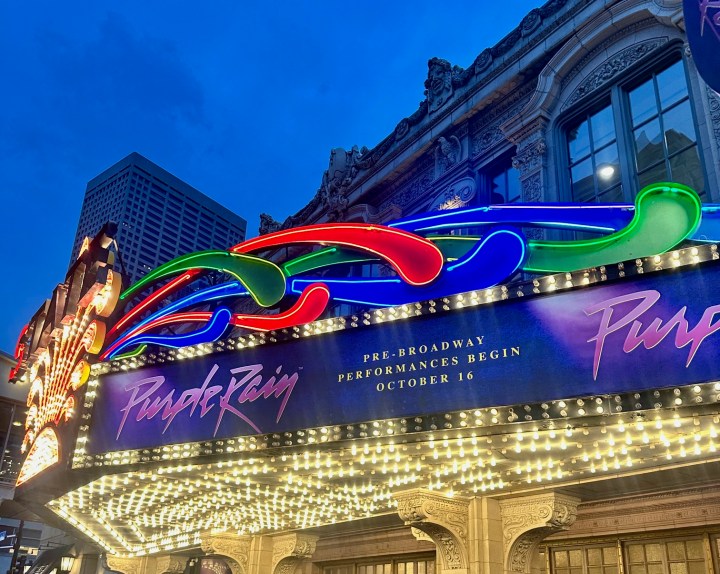
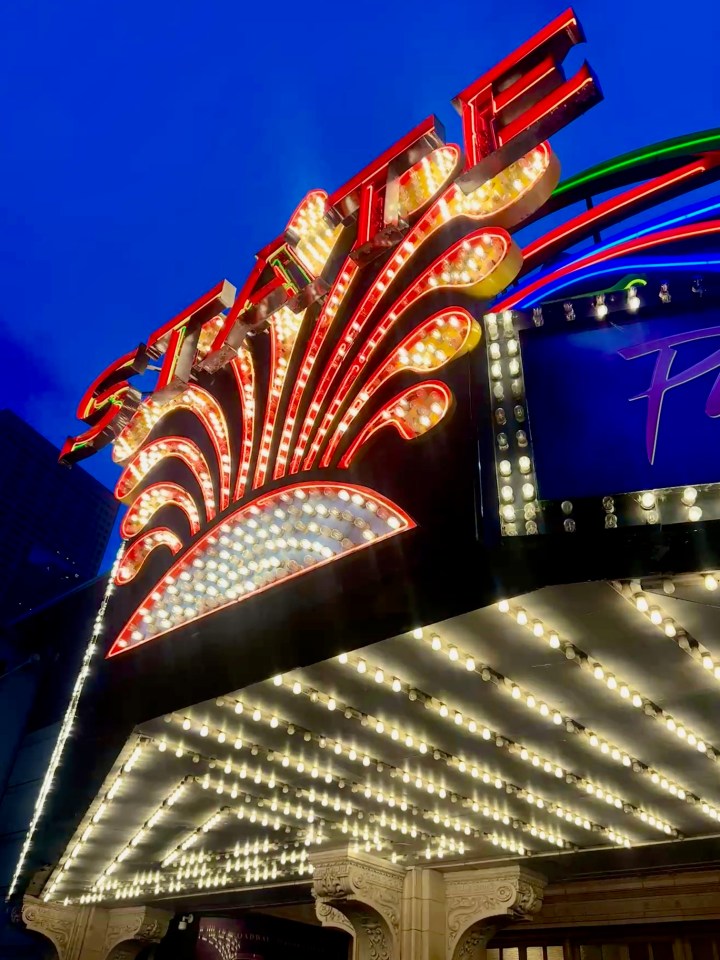
Skepticism around the musical continued to circulate throughout social media, fueled in no small part by early reports that the new musical would “give its extravagant characters a 21st century makeover.” The New Yorker‘s January 2024 lengthy profile of Jacob-Jenkins sheds light on a handful of changes the musical’s creative team would bring to life in the stage adaptation, including fleshing out Apollonia’s character in ways not done in the film and creating more of a redemption arc for The Kid, whose complicated and abusive relationship with Apollonia in the film is neatly tied up at the end but takes on a more complex angle in the musical. The musical also leans much more comfortably into queerness; where the film subtly suggests that Wendy and Lisa may be lovers (they were in real life), the musical allows their relationship to be front and center with no obfuscation. No spoilers here, but after viewing the sold-out opening at Minneapolis’ State Theatre on October 16 it’s safe to say the production accomplished its goal of rewiring Purple Rain for a new generation.
And so, what about the show?
As the house lights dimmed, director Lileana Blain-Cruz stepped out to welcome the audience to opening night, intimating that we were the cast’s first audience. The beauty of attending a show on opening night, especially one that’s Broadway-bound, is that you get to experience a performance that’s still in its infancy; the cast and crew are well-rehearsed, but it’s not necessarily as polished as it will be in a few weeks or by the time it lands in the Big Apple. Throughout the 3-hour performance there were certainly a few hiccups–missed tech cues, lags in dialogue, a few lines flubbed here and there. There’s one pivotal scene in the second act that could do with some editing, and another closer to the end of the show that may also benefit from some minor trims to dialogue in the spirit of showing more and telling less, and it will be interesting to see whether these kinds of revisions make it from Minneapolis to Broadway.
At the heart of Purple Rain, of course, is the music. At the Celebration sneak peek, the creative team shared that the Prince estate had given them access to Prince’s entire catalogue, opening the door for them to incorporate more songs into the musical than appear in the original film and its accompanying album. I was most curious to see what the musical’s team would do with the 9 songs from the film and how they’d leverage Prince’s expansive discography to shape the production. In this department, the musical does not disappoint.
As in the film, the musical opens with “Let’s Go Crazy,” Kollins channeling The Kid/Prince as he delivers the iconic line, “Dearly beloved, we are gathered here today to get through this thing called life.” We’re introduced to The Revolution (Bilaal Avaz as Doc, aka Dr. Fink; Grace Yoo as Wendy; Emma Lenderman as Lisa, Gían Pérez as Bobby [Bobby Z]; and Kondwani Phiri as Mark [Brown Mark]) as dancers work the stage. We also meet key characters Morris (Jared Howelton), Jerome (Antonio Michael Woodard), Jill (Anissa Marie Griego), and Billy (Lawrence Gilliard, Jr., referred to in the musical as Uncle Billy). It’s impossible to ignore that the bulk of the main cast is comprised of Black, Latinx, Asian, and Southeast Asian performers. What’s even more intriguing is the decision to cast non-white actors to portray the white members of The Revolution (Bobby, Doc, and Wendy); although even in the original film the band members were portraying, one could say, caricatures of themselves, they are, after all, real people. I’m fascinated by the casting here, and hope there’s an opportunity for the creative team to share insights as to how and why they made these choices. Also worth noting here that, unlike in the film, The Kid’s mother in the musical production is portrayed by a Black actress (Olga Karlatos appears in the film alongside Clarence Williams, III as The Kid’s father, Francis L.). In the film we’re meant to interpret The Kid as biracial (Prince notoriously floated the idea that he was biracial early in his career, further adding to both the lore and confusion that followed him throughout his public life). Broadway veteran Leon Addison Brown shines as Father in the stage adaptation. (The actress playing his mother isn’t listed in the programme. Stay tuned for updates.)
Back to the music.
The production does an extraordinary job of blending numbers from the original film with unrelated tracks from Prince’s catalogue. I don’t want to give too much away, but the scene where The Kid and Apollonia fall in love is built around a stunning mélange of some of Prince’s greatest love songs. It’s a breathtaking presentation, and a beautiful way to weave more of his music into the production.
Another outstanding aspect of the musical is how it makes so much more room for the female characters than in the original film. In the latter, we meet Apollonia, an aspiring singer new to town, as she sneaks into First Avenue after ditching her cab without paying. In the infamous Lake Minnetonka scene, she tells The Kid she’s from New Orleans. We learn nothing else about her, and her purpose seems to be more of a source of competition for Morris and The Kid than a fully-developed person. Rachel Webb brings Apollonia to life on stage as an ambitious, multi-layered young woman trying to find her way. We learn that she’s got her sights set on New York but has ended up in Minneapolis under unclear but troubling circumstances; there’s something and/or someone she’s running from that goes unnamed, but remains a silent antagonist of sorts for her.
We get to know Jill, portrayed in the film by singer/songwriter Jill Jones, arguably one of the most important figures in Prince’s creative universe throughout the ’80s and into the early ’90s. In the film, she’s woefully underutilized other than to moon over The Kid; outside of her crush on the moody rock star, she’s a waitress at First Avenue who seems to have nothing else to do. In the musical, the character gets to not only have even more personality, but to contribute to an important turning point in the story. Same goes for Apollonia 6 members Brenda (Christina Jones) and Susan (Jaci Calderon). We barely hear them speak in the film, except for Brenda’s (Vanity 6 and Apollonia 6 singer Brenda Bennett) one line where she tells Morris and Jerome they should let them make up their own dance steps. Susan (Vanity 6 and Apollonia 6 singer Susan Moonsie) doesn’t speak at all. Here, however, they have voices, they have opinions, they have ideas. They bring more to the table than “asses wigglin’.”
Wendy (Wendy Melvoin) and Lisa (Lisa Coleman) serve as The Kid’s mirrors in the film, forcing him to confront his selfishness and narrow-minded vision for the band. This tension plays out more completely in the musical, as the duo makes a decision that proves to have serious consequences for The Kid. It’s beautiful to see. And while I can’t say how the real women on whom these characters are based may feel about these portrayals, I love this evolution of the story–especially since the real-life Apollonia, Wendy, Lisa, Jill, Brenda, and Susan are all forces in their own right and significant to Prince’s legacy.
While the musical sticks close to the original story with regard to The Kid’s experience with domestic violence and his parents’ volatile marriage–both critical to how The Kid’s own relationships play out in the film and the musical, in the musical we witness The Kid and his father working through their family’s dysfunction. His mother, we learn, left with The Kid some years before to escape his father’s abuse, and The Kid’s returned on a mission to prove himself as a young adult. The musical makes room for healing and growth, something the film merely hints at. This, I think, is one reason why reinterpreting art originally meant for one medium in a new medium is important; with a stage production, not unlike a book, there’s often more time and space available to allow the story and characters to breathe. With the Purple Rain musical, this opportunity for development is put to good use.
Not unlike in the film, Morris and Jerome–but especially Morris–provide the musical’s comic relief. Jared Knowelton is brilliant in his role, not simply mimicking Morris Day’s iconic mannerisms but infusing them with an even heartier helping of camp. The musical’s reference to the now-cringe-inducing dumpster scene in the film is one of the most hilarious moments I’ve ever seen on stage.
What’s unclear in the stage adaptation is era. The costumes, set pieces, and one of the newer elements of the musical, a TV show spotlighting the artists from The First (the name given to the club in the musical), all scream 1980s. And yet, there’s at least one scene where Apollonia appears to be snapping a selfie of herself and The Kid. Later, The Kid uses a landline phone to call his band, something no 21-year-old in 2025 would do. This isn’t necessarily the most important detail, but it does create a slight continuity glitch if you’re someone who pays attention to those sorts of things.
Purple Rain Broadway is an ambitious feat, a courageous leap of faith that’s most successful in its treatment of Prince’s music. It’s clear that everyone involved in the production holds Prince in high regard, and they’ve taken care to present his music in ways that innovate while remaining true to his original expression.
As a musician, I know first hand how songs transform when played frequently live. We get know the music more intimately, discover aspects of it we hadn’t noticed before, and become more comfortable in our approach to it.
I believe that, with time, the cast of Purple Rain Broadway will grow into their characters and cultivate deeper relationships with the material. This show has an incredible amount of potential and is already off to a strong start. Here’s to them uncovering everything there is to experience “underneath the purple rain.”
Discover more from Rhonda Nicole
Subscribe to get the latest posts sent to your email.
